
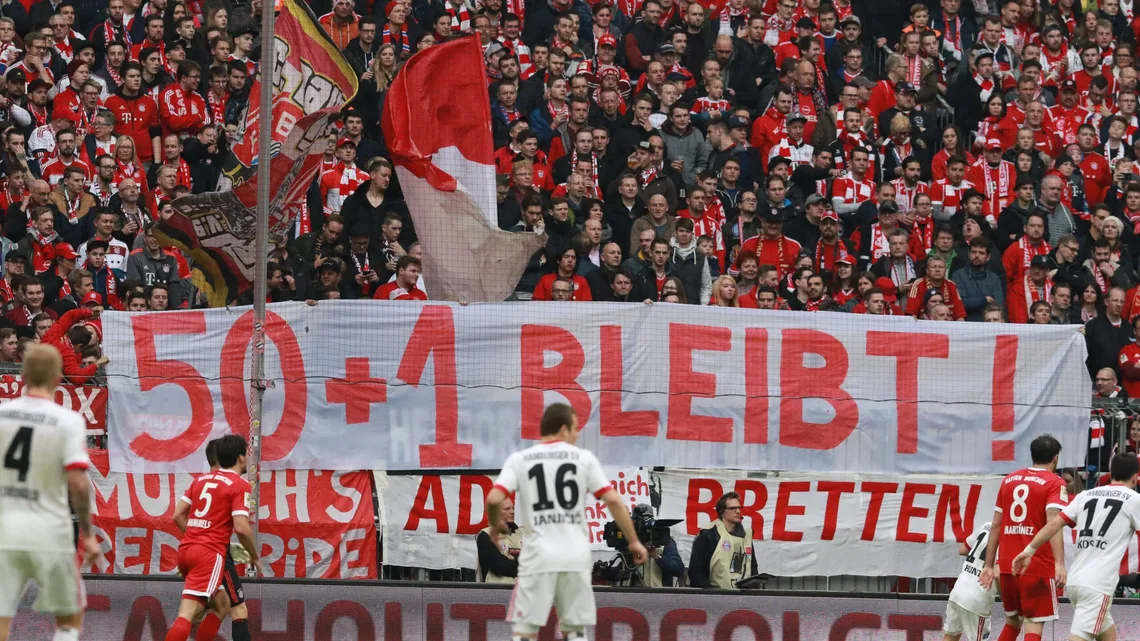
Germany’s model of football-club governance has received another strong institutional endorsement. On 12 August 2026, the Bundesliga announced that Germany’s Federal Cartel Office, after a multi-year review, had no fundamental objection to the core principle of the 50+1 rule.
The rule is designed to ensure that club members retain a majority of voting rights even when the professional football operation is run through a separate company and receives private investment.
What does 50+1 mean?
The name refers to at least 50 per cent plus one vote. The member association representing the parent club must retain the majority of voting rights in the company that operates the professional team.
Private investors can contribute capital and own a significant economic stake, but they should not obtain majority control over decision-making.
The aim is not to remove private capital from football entirely. The aim is to prevent one individual or company from taking over a club and making key decisions without the consent of its members.
Why was the rule legally reviewed?
The 50+1 rule has repeatedly been challenged on the grounds that it may restrict competition and treat clubs differently.
In 2018, the German Football League asked the Federal Cartel Office to examine whether the rule complied with competition law. The process lasted more than eight years.
In its final assessment in August 2026, the authority raised no fundamental objection to the core rule. It accepted that preserving club identity and allowing the broader public to participate in governance through membership can justify special treatment compared with ordinary market rules.
However, not every issue has been resolved. Particular attention remains on transparency, consistent application of the rule and existing exceptions. The Bundesliga and clubs from the first and second divisions now need to find solutions that provide greater legal certainty.
How does the model work in practice?
German clubs can place their professional teams in corporate entities, sell shares and attract investors. Nevertheless, the parent club — and therefore its members — must retain control over voting rights.
Legal structures differ from club to club. The common principle is that an investor should not be able to take unilateral control of the club.
There are also historical exceptions linked to companies that supported certain clubs for decades. These exceptions are among the most controversial parts of the system because they raise the question of whether the rule is applied equally to everyone.
What does 50+1 give supporters?
The rule gives club members an institutional mechanism for influence. Depending on the club’s statutes, members can participate in general assemblies, elect club bodies and influence the strategic direction of the club.
This creates a barrier to a complete takeover by a private owner and helps preserve the club’s identity, traditions and connection with its local community.
Membership alone, however, is not enough. The real influence of supporters depends on the statutes, the quality of internal democracy, management transparency and the genuine ability of members to hold leadership to account.
What does 50+1 not guarantee?
The rule does not guarantee good governance, sporting success, financial stability or low ticket prices.
A club can formally comply with 50+1 while still having closed management structures, weak communication with members or opaque business decisions. A democratic structure has value only if members have access to information and a real opportunity to participate in decision-making.
The model should therefore not be romanticised. Its greatest value is not that it automatically solves every problem, but that it creates institutional protection against the complete concentration of power in the hands of a single owner.
Could the model work in the Balkans?
Simply copying the name “50+1” would not be enough. For a similar system to make sense in Balkan football, clubs would need:
- clearly defined and accessible membership;
- a reliable membership register;
- democratic and regular general assemblies;
- public rules for electing club bodies;
- transparent financial reports;
- protection from political and business capture;
- real mechanisms for holding management accountable to members.
Without those elements, the rule could easily become decoration while the same interest groups continued to control clubs behind the scenes.
The lesson of the German model
The most important message of 50+1 is not that investors are unnecessary. Professional football needs capital.
The message is that investment does not have to mean surrendering the club’s entire identity and control. It is possible to make room for capital while preserving the club as an institution of its members and community.
For Balkan football, this is an important debate. The key question is not only who finances a club, but who has the right to decide its future.
Sources: Bundesliga — “Bundesliga welcomes Federal Cartel Office’s statement regarding 50+1 rule”, 12 August 2026; Bundesliga — “Explaining the Bundesliga’s 50+1 rule”.
Photo: LakoPress/imago | Source: Bundesliga.